

Bitcoin's price has climbed to $70,164, reflecting a solid 4.45% increase over the last 24 hours with a high of $70,503 and a low of $66,964. This stabilization comes amid a resurgence in spot Bitcoin ETF inflows, snapping a prolonged outflow streak and underscoring institutional confidence in BTC's long-term value. For beginners eyeing BTC exposure in 2026, these developments make ETFs the most straightforward entry point, blending crypto's upside with traditional market accessibility.
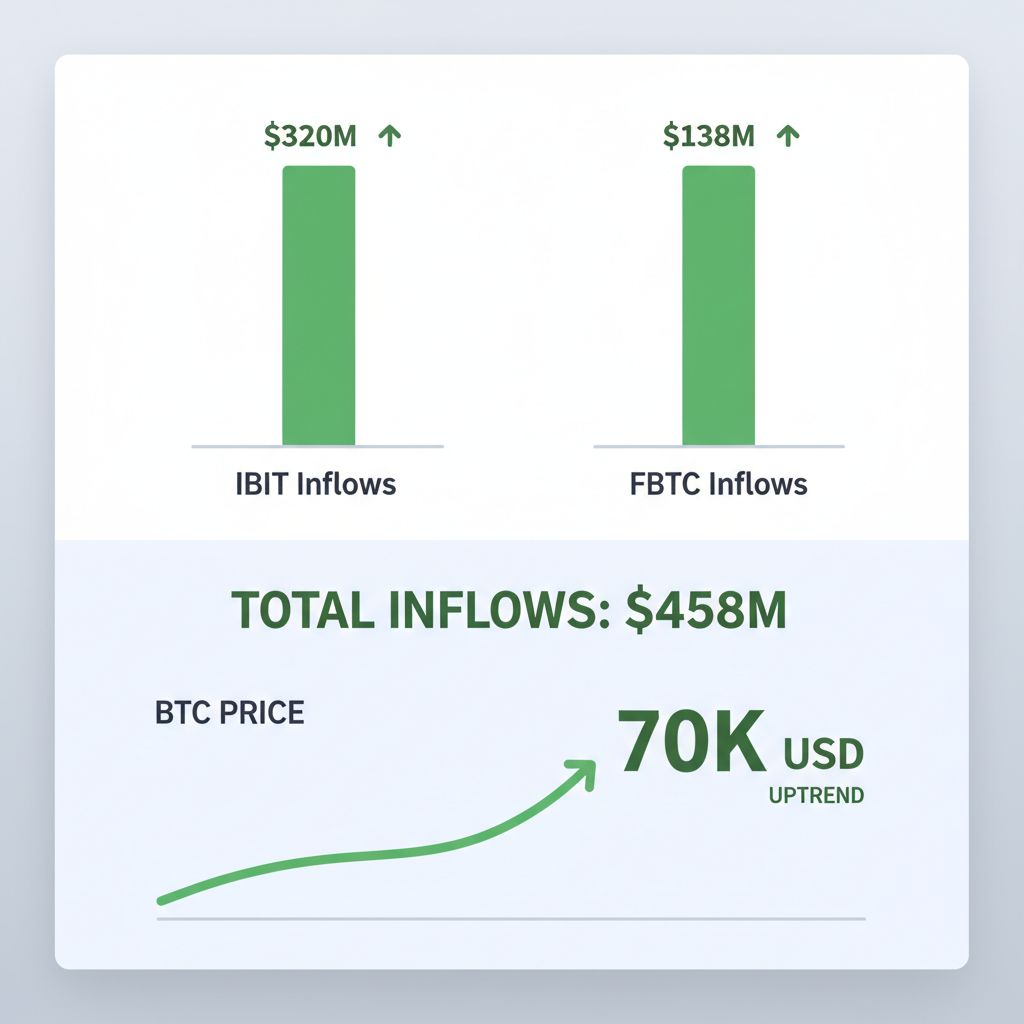
Investors have watched spot Bitcoin ETFs closely since their launch, and early March 2026 delivered a pivotal shift. After months of net outflows, these funds posted strong positive flows, with daily hauls reaching hundreds of millions. On March 2, U. S. spot Bitcoin ETFs drew in $458.2 million net, led decisively by BlackRock's iShares Bitcoin Trust (IBIT) at $263.2 million. Fidelity's Wise Origin Bitcoin Fund (FBTC) followed with $94.8 million, and Bitwise's Bitcoin ETF (BITB) added over $36 million. This momentum persisted: March 3 saw $225.2 million total, again topped by IBIT; March 4 brought $306.6 million into IBIT alone, capturing 66% of the day's activity; and March 5 rounded out roughly $500 million across ten of eleven funds.
IBIT's Dominance Signals Institutional Recommitment
BlackRock's IBIT has emerged as the undisputed leader, consistently absorbing the lion's share of inflows. This isn't mere volume chasing; it reflects sophisticated capital allocation. With total assets under management across U. S. Bitcoin ETFs surpassing $88 billion, IBIT's performance highlights how major players like BlackRock are positioning for BTC's maturation. In my two decades analyzing markets, such concentrated flows often precede broader rallies, as they validate Bitcoin's role beyond speculation into portfolio staples.
Yet, the picture isn't flawless. March 6 recorded $227.83 million in net outflows as BTC dipped below $71,000, with IBIT shedding $88.74 million. Still, the week closed positive at $917 million net inflows, a testament to underlying demand. Geopolitical tensions and macroeconomic whispers may have prompted tactical pauses, but the data points to resilience. Beginners should note: these swings are normal in crypto-linked assets, yet ETFs shield you from direct custody risks like hacks or lost keys.
Why Now? Decoding the Inflow Surge After Five Months of Redemptions
The prior five-month outflow streak stemmed from profit-taking after BTC's post-ETF launch highs, coupled with regulatory scrutiny and equity market competition. What flipped the script? Renewed optimism around Bitcoin's scarcity narrative, especially with the halving's lingering effects and ETF maturation. Institutional confidence is roaring back, as evidenced by weekly surges like $568 million reported across sources. For context, this mirrors patterns in gold ETFs during uncertainty, where BTC increasingly serves as "digital gold. "
From a risk management lens, drawing on my FRM certification, these inflows reduce BTC's beta to traditional assets, making it more palatable for conservative portfolios. Total holdings reflect this: recent days added thousands of BTC to ETF reserves. As Bitcoin holds $70,164, this institutional tailwind could propel further gains, but volatility demands discipline.
Bitcoin (BTC) Price Prediction 2027-2032
End-of-year projections in USD based on ETF inflows, 2028 halving, institutional adoption, and market cycles amid 2026 stabilization at ~$70,000
| Year | Minimum Price | Average Price | Maximum Price |
|---|---|---|---|
| 2027 | $70,000 | $110,000 | $160,000 |
| 2028 | $100,000 | $170,000 | $250,000 |
| 2029 | $130,000 | $220,000 | $320,000 |
| 2030 | $160,000 | $270,000 | $400,000 |
| 2031 | $200,000 | $330,000 | $480,000 |
| 2032 | $240,000 | $400,000 | $600,000 |
Price Prediction Summary
Bitcoin's price is forecasted to grow progressively from 2027-2032, with average prices rising from $110,000 to $400,000, fueled by sustained ETF inflows (e.g., BlackRock IBIT leading resurgence), the 2028 halving, and broader adoption. Bearish mins reflect potential macro pullbacks, while bullish maxes capture cycle peaks up to 8x current levels.
Key Factors Affecting Bitcoin Price
- Robust ETF inflows signaling institutional confidence (e.g., $458M+ daily surges in early 2026)
- 2028 Bitcoin halving reducing new supply and historically driving bull markets
- Regulatory clarity and mainstream integration via ETFs for easier onboarding
- Macro trends: lower interest rates, inflation hedging, geopolitical stability
- Technological upgrades (e.g., scalability) and competition from altcoins
- Market cap expansion toward $5-10T, implying $250K-$500K+ BTC prices
Disclaimer: Cryptocurrency price predictions are speculative and based on current market analysis. Actual prices may vary significantly due to market volatility, regulatory changes, and other factors. Always do your own research before making investment decisions.
Beginners' Fast-Track: Selecting and Accessing Bitcoin ETFs in 2026
Gaining BTC exposure via ETFs sidesteps the steep learning curve of wallets and exchanges. These funds track Bitcoin's spot price through regulated custodians, trading like stocks on major exchanges. Start by researching top performers: IBIT boasts low fees around 0.25% (waived initially), robust liquidity, and BlackRock's pedigree. Compare with FBTC's 0% fees or BITB's competitive structure. Each holds physical BTC, ensuring direct price linkage without futures complexities.
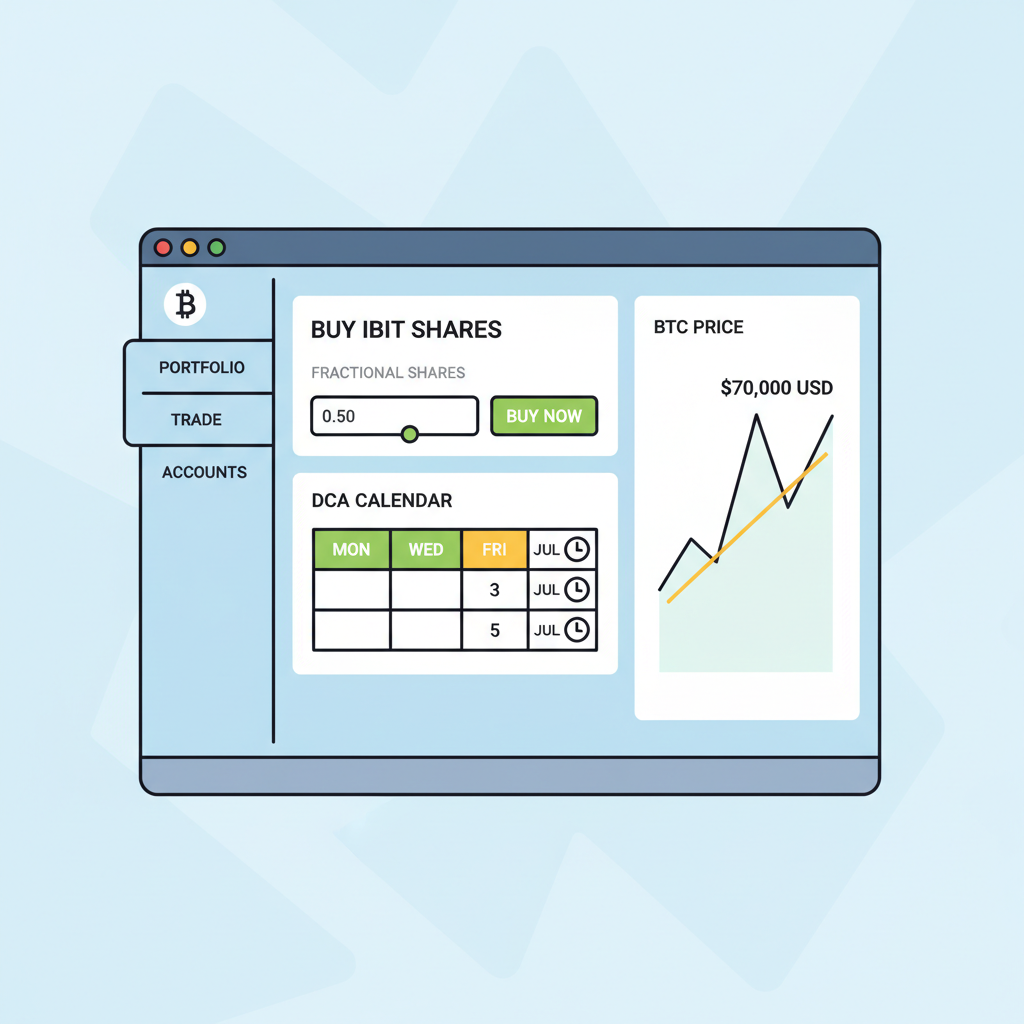
Next, pick a brokerage. Platforms like Fidelity, Charles Schwab, or Vanguard offer seamless access, often with zero-commission trades and fractional shares ideal for small starters. Verify SEC registration and SIPC insurance for peace of mind. Fund your account via bank transfer, aim for dollar-cost averaging to navigate volatility, buying fixed amounts weekly regardless of price at $70,164 or dips.
This guide aligns perfectly with current flows, emphasizing secure onboarding amid IBIT's lead.
Once your brokerage account is set up, executing your first trade is straightforward. Search for the ETF ticker - IBIT for BlackRock, FBTC for Fidelity - review the live quote tied to Bitcoin's $70,164 price, and place a market or limit order. Fractional shares let you start small, say $100, capturing BTC upside without full coin commitment. Monitor via the app's dashboard, where real-time charts mirror spot movements.
Comparing Top Spot Bitcoin ETFs: Fees, Flows, and Fit for Your Portfolio
Choosing the right ETF hinges on fees, liquidity, and custodian strength. BlackRock's IBIT dominates with its scale, but Fidelity's zero-fee FBTC appeals to cost hawks, while ARK's ARKB offers innovation ties. Inflows data underscores IBIT's pull: it snagged over half of recent billions, a proxy for smart money flows. Beginners benefit from this transparency - no opaque futures contracts, just audited BTC holdings.
Top Bitcoin ETFs Comparison (Early March 2026)
| Ticker | Expense Ratio (%) | AUM ($B) | Avg. Daily Volume (shares) | YTD Return (%) | Mar 2 Net Inflow ($M) |
|---|---|---|---|---|---|
| IBIT | 0.25 | 38.5 | 25M | +25% | 263.2 |
| FBTC | 0.00 | 12.4 | 8.5M | +25% | 94.8 |
| BITB | 0.20 | 4.1 | 3.2M | +25% | 36 |
These metrics matter because lower fees compound over time, especially as BTC holds $70,164 amid institutional bets. My CFA lens spots IBIT's edge in risk-adjusted returns, thanks to BlackRock's $10 trillion oversight. Yet diversify across 2-3 to hedge provider risks.
Navigating Risks and Building a Resilient BTC ETF Strategy
Bitcoin ETFs aren't risk-free. Volatility persists - witness the March 6 outflow when BTC slipped below $71,000 - amplified by crypto's 24/7 nature clashing with stock hours. Regulatory shifts, like potential staking approvals, could boost or buffet prices. Counter this with position sizing: cap BTC exposure at 5-10% of portfolio, rebalance quarterly.
Dollar-cost averaging shines here, smoothing entries above or below $70,164. Pair with macro hedges - think T-bills for liquidity. From experience, ignoring flows like the $917 million weekly net invites FOMO traps; track them weekly via ETF trackers to time dips.

Tax efficiency adds appeal: ETFs defer capital gains until sale, unlike direct BTC trades triggering events. For retirement accounts, they're seamless - Roth IRAs now hold BTC via these vehicles, supercharging long-term growth tax-free.
Easiest 2026 Beginner Guide: Buy Bitcoin ETFs (IBIT/FBTC) in 5 Steps Amid $70K Rally



Staying ahead means vigilance. Institutional flow trackers reveal sentiment shifts early, like IBIT's 66% daily dominance. As assets top $88 billion, Bitcoin's liquidity deepens, narrowing ETF premiums to spot.
Geopolitical wildcards linger, but history favors assets with scarcity and network effects. BTC's post-halving supply crunch, plus ETF accessibility, positions it as a hedge against fiat debasement. Beginners entering now, via regulated ETFs, sidestep exchange hacks while riding this wave. With $70,164 as the new floor, disciplined accumulation builds wealth patiently, turning volatility into virtue.



No comments yet. Be the first to share your thoughts!